

Mole mapping is a careful, in-person way of checking and recording moles so any changes can be assessed properly over time. At City Dermatology Clinic, this is done by a doctor using direct skin examination, dermatoscopy, and clinical photographs where appropriate – not AI scanners or photo-only checks. Some moles are simply monitored, others reassured as benign, and in some cases further investigation or removal is discussed.
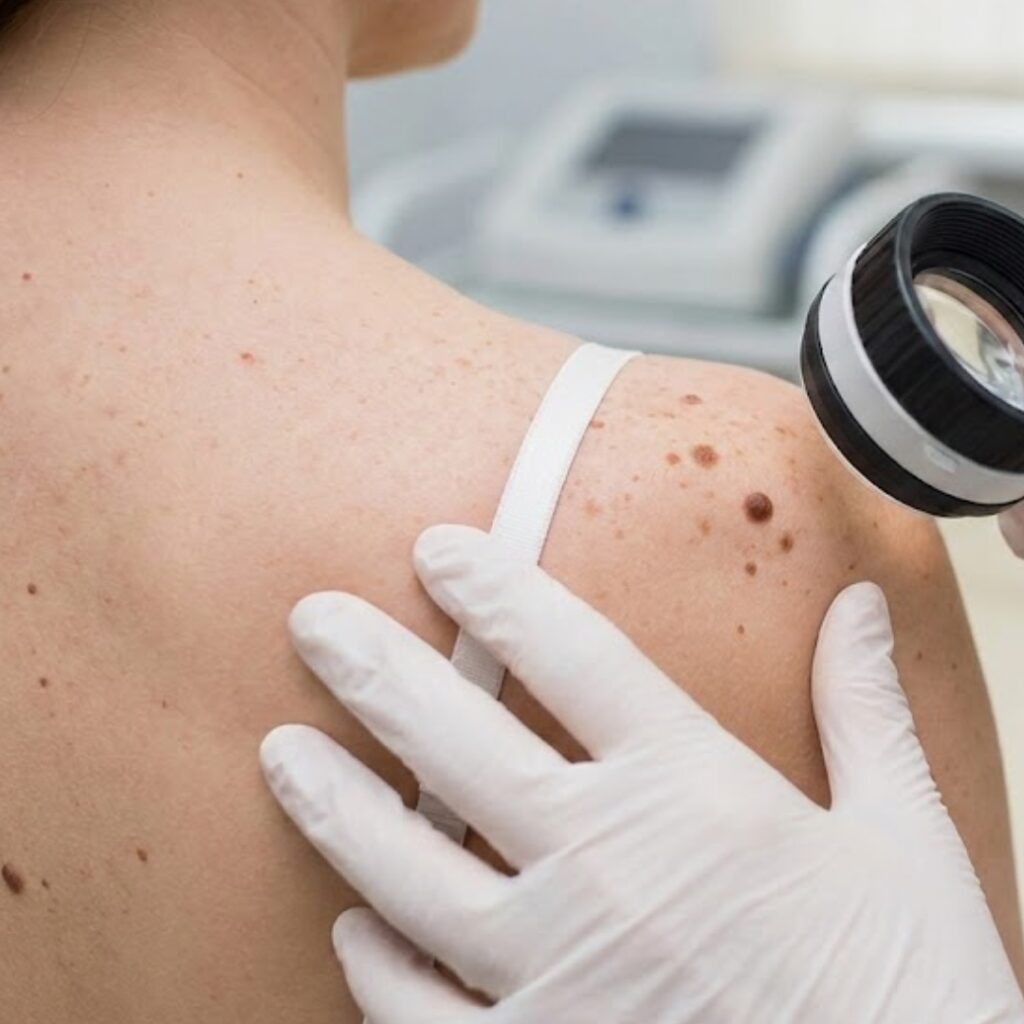
Mole mapping looks at your skin as a whole, not just individual moles in isolation. During assessment, the doctor considers how moles compare with one another, whether certain lesions stand out, and whether any patterns suggest the need for closer observation.
This approach is particularly useful when someone has multiple moles, as it helps identify lesions that behave differently from the rest. Part of the process is also deciding which moles do not require documentation or follow-up, to avoid unnecessary monitoring or intervention.
Mole mapping supports clinical judgement, but it does not replace it. Findings are interpreted alongside your medical history, skin type, and any changes you have noticed.
The assessment is carried out in person and is led by direct examination of the skin. Selected moles are examined using a dermatoscope, which allows the doctor to assess pigment structures and features beneath the surface that cannot be seen with the naked eye.
Where monitoring is appropriate, medical photographs are taken using a clinic iPad system to document appearance and location. These images are used as reference points and are always interpreted alongside repeat clinical examination.
Typical stages of a mole mapping appointment include:
Discussion of your skin concerns and background
Full or targeted skin examination
Dermatoscopic assessment of selected moles
Clinical photography where appropriate
Explanation of findings and recommendations
Image-based mole checks and AI scanning systems rely on photographs taken outside a clinical setting. While they may flag obvious changes, they have important limitations and cannot assess moles in full clinical context.
Common limitations of photo-only or AI-based checks include:
Inability to assess texture, firmness, or depth
Variability caused by lighting, camera quality, and angle
No comparison with surrounding skin or other moles
Lack of clinical history and examination findings
In many cases, these services still advise in-person review or forward images to a dermatologist. Direct examination with dermatoscopy remains the standard approach when accurate assessment is required.
Mole mapping is not necessary for everyone. It is most often used when monitoring over time provides meaningful clinical benefit.
It may be considered if you:
Have a large number of moles
Have moles that look different from one another
Find it difficult to check your skin yourself
Have had atypical moles removed in the past
Feel unsure whether a mole has changed
If your concern relates to a single, specific mole, a focused mole check may be more appropriate. This is discussed during consultation.
Most moles assessed during mapping are benign and do not need treatment. Some are monitored over time, while others may require no follow-up once assessed.
If a mole appears atypical or raises concern, the doctor will explain why and discuss appropriate next steps. In some cases, this may include removal for further assessment. You can read more about how moles are assessed and, where appropriate, removed on our mole removal page.
The table below outlines how different findings are typically managed:
| Clinical finding | Typical approach |
|---|---|
| Benign, stable mole | Reassurance or no follow-up |
| Benign but atypical features | Monitoring with review |
| Change or concerning features | Further investigation or removal |
| Unclear findings | Short-term review or second assessment |
Any decision is made carefully, based on examination findings, and discussed with you in full.














Mole assessments and treatments at our clinic are carried out by consultant dermatologists and plastic surgeons with experience managing both benign and clinically significant skin lesions. All decisions are based on in-person examination, routine use of dermatoscopy, and histology where indicated. This ensures each mole is assessed and, if required, treated according to its individual features and clinical context, rather than appearance alone.

MBBS, MD, MRCP

MD, PhD

BSc, MBChB, FRCS

MBBS, MRCS

MBBS, FRCS

MB ChB FRCS

MBBS, MSc, FRCS

MA MBBS FRCS

MD, PhD, CCT

MD, MSc, FRCS, FEBOPRAS

BSc, MBChB, FRCS

MBBS, MSc, FRCS
The length of the appointment depends on how many moles need to be assessed and whether documentation is required. Some appointments are relatively brief, while others take longer if multiple areas are examined or photographs are taken for monitoring. The doctor will work at an appropriate pace to ensure the assessment is thorough rather than rushed.
No special preparation is usually required. It can be helpful to wear clothing that allows easy access to the areas you would like checked, and to avoid heavy makeup, fake tan, or nail varnish over areas of concern, as these can interfere with examination. If you have noticed changes in a particular mole, noting when you first observed them can also be useful.
Not necessarily. Only moles that are clinically relevant are documented. Many moles do not need to be photographed or followed over time. Part of the assessment involves deciding which moles, if any, would benefit from monitoring and which do not require ongoing attention.
Mole mapping is sometimes performed in younger patients, but it is not routinely required and is considered on a case-by-case basis. Factors such as age, skin type, number of moles, and clinical concern all influence whether mapping is appropriate. This is discussed during consultation.
There is no fixed schedule. Some people may only need a single assessment, while others may be advised to return for review after a period of time. The interval, if any, depends on what is seen during the examination and whether there are moles that warrant monitoring.
No. Mole mapping is a supportive tool, not a substitute for ongoing awareness of your skin. You should still seek assessment if you notice a new mole, a change, or anything that causes concern, even if you have had mole mapping in the past. Each new concern should be assessed on its own merits.