Mole Check Birmingham

Callback Request.

This field is for validation purposes and should be left unchanged.
Name(Required)

City Dermatology Clinic
4.9 Stars – Based on 1410 Patient Reviews
google logo

It’s natural to feel concerned when a mole changes in size, colour or shape, or when a new skin lesion appears. A professional mole check can help assess whether a mole appears benign or has features that may require further investigation, monitoring or removal. At our Birmingham clinic in King’s Heath, experienced dermatologists use detailed visual examination and dermoscopy to assess moles and other skin lesions. Your appointment provides a thorough clinical assessment, with clear advice on the findings and any recommended next steps.

A mole should be assessed by a dermatologist if it changes in appearance, behaves differently, or simply looks unusual compared with your other moles. Most moles are harmless, but early review is essential because melanoma can develop from new or existing moles and often begins with subtle visual changes.


Persistent changes

A mole that changes in size, colour, shape, or texture over several weeks should be assessed. Gradual evolution is one of the most reliable indicators that something needs medical review.


New moles in adulthood

Any new mole appearing after the age of 30 warrants a check, especially if it looks different from your other moles.


Visible symptoms

Bleeding, itching, crusting, or becoming tender are signs the mole may be irritated or require further evaluation.


Asymmetry or irregular borders

Moles that look noticeably uneven or have edges that are jagged or blurred are more likely to need medical assessment.


Family or personal history

If you have a history of melanoma, atypical moles, or strong sun damage, regular skin checks are recommended even if a mole appears unchanged.

Melanoma symptoms can vary widely, but the key concern is any mole or pigmented mark that begins to behave differently from the rest of your skin. Melanoma often develops from an existing mole, but it can also appear as a new mark, particularly on sun-exposed areas. Changes in colour, shape, size, or surface texture are the most common warning signs, and these changes can occur gradually or over a relatively short period.


A mole that becomes darker, develops multiple colours, or shows irregular shading should be assessed promptly. Edges that begin to blur, form notches, or lose symmetry can also indicate abnormal cell activity. Some melanomas grow outwards in an asymmetric or raised pattern, while others spread deeper into the skin before becoming visible on the surface.


Symptoms aren’t always visual. Persistent itching, a new sensation of discomfort, or tenderness around a mole can signal underlying inflammation. Bleeding, crusting, or a mole that begins to ooze are more advanced warning signs and should be evaluated without delay. A mole that appears after the age of 30 and grows quickly is also considered higher risk.


Changes in sensation or texture, such as a mole becoming firm, rough, or developing a new raised area, can indicate progression beneath the skin. Melanoma can sometimes resemble a small wound that doesn’t heal normally, particularly on the legs or back.


These symptoms do not confirm melanoma, but they are medically significant and warrant assessment by a dermatologist. Early detection remains the most important factor in improving outcomes, and any noticeable or persistent change should be checked as soon as possible.

StepWhat to expect
1. Booking and pre-assessmentYou’ll book a mole or full skin check with one of our skin cancer specialists. We’ll ask brief questions about your skin type, family history of melanoma, previous sun exposure, and any moles you’re worried about.
2. Specialist consultationYour appointment is carried out by a consultant dermatologist or plastic surgeon with specific training in skin cancer. They’ll take a focused history, examine your skin, and identify any moles or lesions that need closer assessment.
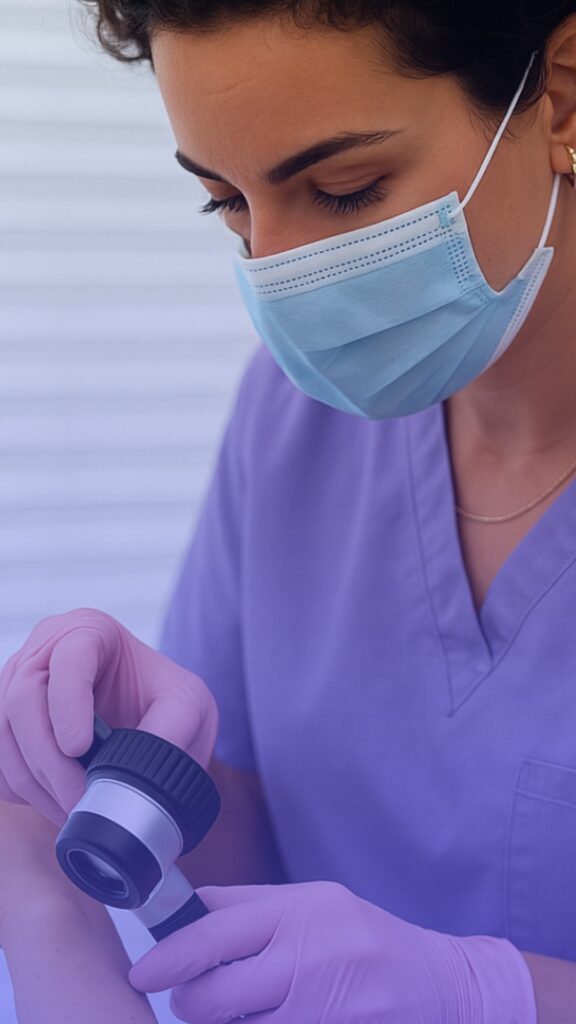
3. Dermoscopic assessmentSuspicious or changing moles are examined with a dermatoscope, a magnifying device that shows pigment patterns and structures not visible to the naked eye. This helps distinguish benign moles from lesions that may require biopsy or removal.
4. Clinical decisionBased on the clinical and dermoscopic findings, the doctor will explain whether a mole appears benign, needs monitoring, or should be removed for safety. You’ll have the chance to ask questions about risk, next steps, and treatment options.
5. Mole removal or biopsy (if needed)When removal is recommended, the procedure is performed by a consultant plastic surgeon at our clinic. Under local anaesthetic, the mole is removed using the most appropriate technique (usually excision or shave removal), and the sample is sent for histology to rule out melanoma or other skin cancers.
6. Histology and resultsAll medically indicated removals are analysed by a specialist pathology lab. Your results are reviewed by your consultant, who will explain the report, confirm whether further treatment is required, and arrange any follow-up if needed.
7. Follow-up and ongoing monitoringYou’ll be given clear advice on self-examination, sun protection, and when to return for future checks. If you’re at higher risk of skin cancer, your doctor may recommend regular screening intervals.
ServiceWhat It Involves
Full Body Mole CheckA head-to-toe examination carried out by a dermatology specialist or plastic surgeon trained in dermoscopy. Each mole is assessed for symmetry, borders, colour patterns, diameter, and structural clues that may indicate early melanoma. This is recommended for patients with multiple moles, previous skin cancer, new or changing lesions, or fair skin with a history of sun exposure.
Single Mole AssessmentA focused dermoscopic review of one specific mole that has changed or appears unusual. The doctor evaluates pigment structure, vascular patterns, and any features that warrant biopsy or removal. This is suitable for patients concerned about a single lesion rather than needing full-body screening.
Surgical Mole Removal & BiopsyA dermatologist or plastic surgeon removes the mole using either shave excision or full surgical excision. Suspicious or atypical moles are always sent for histology to confirm diagnosis and rule out melanoma. This method allows complete removal with precise wound closure to minimise scarring.
Diagnostic BiopsyIf a mole requires medical clarification before full removal, the doctor may perform a punch or excisional biopsy. The sample is analysed by a specialist dermatopathologist. Results guide whether further surgical treatment or monitoring is needed.
Mole Mapping (Not Offered)High-resolution imaging used to track moles over time and detect subtle changes linked to early melanoma. While we do not currently provide mole mapping, our doctors carry out thorough clinical examinations and dermoscopic assessments to identify moles needing further investigation or removal.

Mole Check Reviews

What Our Patients Say

Our Team

Our Mole Check Specialists

Our clinic is led by consultant dermatologists and experienced specialist doctors who provide comprehensive assessment of moles and other skin lesions. Our clinicians are GMC-registered and experienced in mole assessment, dermoscopy and the identification of lesions that may require further investigation. Where appropriate, they can advise on monitoring, biopsy or removal, ensuring each patient receives clear, evidence-based guidance tailored to their individual findings.

Our clinic is led by consultant dermatologists and experienced specialist doctors who provide comprehensive assessment of moles and other skin lesions. Our clinicians are GMC-registered and experienced in mole assessment, dermoscopy and the identification of lesions that may require further investigation. Where appropriate, they can advise on monitoring, biopsy or removal, ensuring each patient receives clear, evidence-based guidance tailored to their individual findings.

Cost of Mole Checks in Birmingham

A private mole check includes a detailed examination by a consultant dermatologist, with time for mole assessment, dermoscopy and medical advice. If removal or biopsy is recommended, this can often be discussed and arranged during the same visit, where appropriate.

Private Mole Check Pricing

  • Mole Removal Consultation £100
  • Full Body Mole Check (Skin Cancer Mole Check) £250
  • Histopathology Lab Analysis £180

Why Choose Us?

  • Experienced consultant dermatologists providing specialist mole assessment and care.
  • Detailed mole mapping and dermoscopy to support thorough assessment of skin lesions.
  • Private mole checks in Birmingham, with convenient appointments in King’s Heath.
  • Transparent pricing with clear costs for consultation, full body mole checks and histopathology.

Make an Enquiry

This field is for validation purposes and should be left unchanged.
Name(Required)