

Skin tags (acrochordons) are harmless, soft growths that commonly appear on the neck, underarms, eyelids, chest, or groin where skin rubs together. They’re benign but can become irritated, catch on clothing or jewellery, or cause cosmetic concern. At City Dermatology Clinic in central London, removal is carried out by GMC-registered dermatologists and doctors using precise, minimally invasive techniques such as electrocautery or surgical snip excision. Treatment is quick, performed under local anaesthetic, and designed to minimise discomfort and healing time.
Before your skin tag removal, your doctor will examine the area and recommend the most suitable method based on the size, location, and type of lesion. We offer several safe and reliable treatment options:
A precise, quick procedure where the skin tag is removed at its base using a sterile scalpel. This method is ideal for larger or thicker tags and allows complete removal in a single visit.
This technique uses controlled heat to cut and cauterise the skin tag. It’s highly effective for small to medium-sized tags and helps minimise bleeding during the procedure.
Cryotherapy freezes the skin tag using liquid nitrogen. The tag dries, darkens, and falls away naturally over the following days. This is best suited for small, superficial tags.
A focused medical laser is used to vaporise the skin tag with precision. It’s a fast, minimally invasive option ideal for cosmetically sensitive areas where accuracy matters.
Skin tags are benign, soft growths that form on the skin at points where friction is common. They are not dangerous, do not turn into cancer, and usually cause no medical symptoms unless irritated. Most people develop them gradually over time, and their appearance can vary depending on location and skin type.
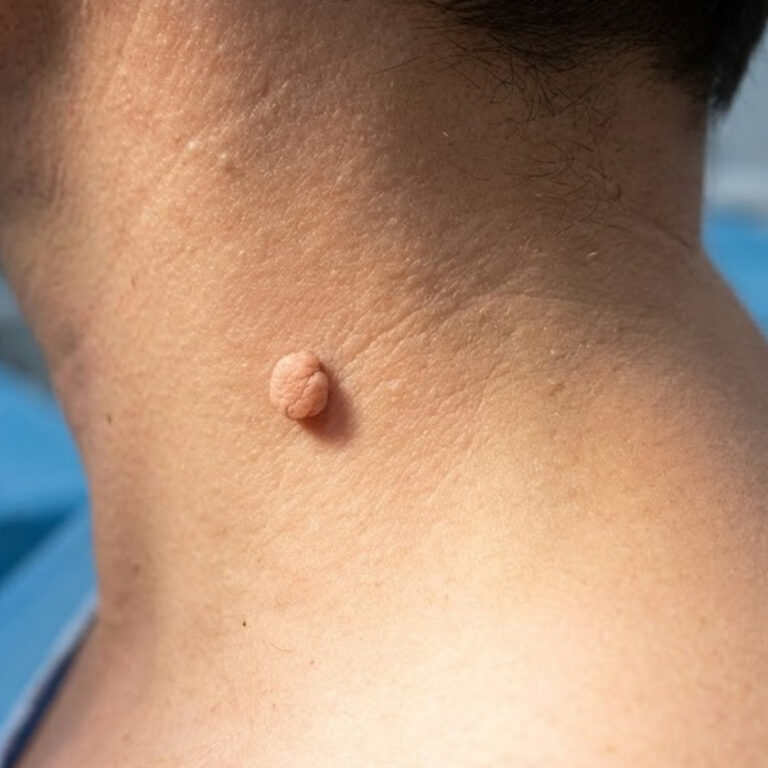
Skin tags are small, flesh-coloured growths attached to the skin by a thin stalk. They may be smooth or slightly wrinkled, often feel soft to the touch, and range from a few millimetres to over a centimetre in size. Although harmless, they can become irritated by clothing, jewellery, shaving, or physical activity.
Common locations include:
• neck
• armpits
• groin
• under the breasts
• eyelids
• abdomen
• the anal area (perianal skin tags)
Several factors influence their formation:
• Friction: the most common trigger; rubbing skin encourages new growths.
• Genetics: many people inherit a tendency to develop them.
• Hormonal changes: pregnancy and other hormonal shifts can increase numbers.
• Age: they are more common from mid-life onwards.
• Weight and skin folds: areas where skin rubs together are more prone.
• Insulin resistance: more common in people with metabolic conditions.
Skin tags normally have no symptoms. However, irritation can cause:
• redness
• tenderness
• snagging or bleeding
• discomfort around high-friction areas
• hygiene issues if located in the groin or anal region
Tags that suddenly change appearance, bleed repeatedly, or grow unusually fast should be checked to confirm they are not a different type of skin lesion.
• a growth is painful, rapidly growing, or dark in colour
• you’re unsure whether the lesion is a skin tag or something else
• the tag affects your vision (eyelid tags)
• a perianal skin tag causes hygiene difficulties or discomfort
| Type of Skin Tag | Description & Typical Locations |
|---|---|
| Common Skin Tags (Acrochordons) | Soft, flesh-coloured growths found on the neck, armpits, chest, under the breasts, and groin. Usually harmless and easily removed. |
| Irritated or Inflamed Skin Tags | Tags that become red, sore, or swollen due to friction from clothing, jewellery, or shaving. Often removed to prevent ongoing discomfort. |
| Large or Pedunculated Skin Tags | Bigger skin tags with a long stalk, sometimes catching on clothing or causing cosmetic concerns. Suitable for excision or electrosurgery. |
| Multiple Skin Tags | Clusters of small tags commonly seen in the neck, underarms, or groin. These can be treated safely in the same session. |
| Genital Skin Tags | Benign skin tags found on the groin, inner thigh, penis, vulva, or pubic area. Assessed and removed discreetly by experienced doctors. |
| Anal / Perianal Skin Tags | Soft folds of skin around the anal area, often developing after fissures, haemorrhoids, or irritation. Removal is performed with care to ensure comfort, hygiene, and proper healing. |
| Stage | What to Expect |
|---|---|
| Initial assessment | A clinician examines the skin tag’s size, location, and characteristics to confirm it is benign and suitable for removal. Any signs of atypical features will prompt medical review before treatment. |
| Treatment day | Removal is performed using the chosen technique (excision, electrosurgery, cryotherapy, or laser). Local anaesthetic may be used depending on method and location. Most procedures are completed within minutes. |
| First 24–48 hours | Mild redness, slight tenderness, or a small crust may form. The area should be kept clean and dry. A light dressing may be advised for friction-prone areas (neck, groin, underarms, or perianal region). |
| Days 3–7 | The treated site begins to dry and heal. Any initial scab falls away naturally. Itching can occur as the skin repairs, but there should be no significant pain. Avoid picking or rubbing the area. |
| Week 2–3 | New skin forms over the site. Colour differences (pink, brown, or slightly darker pigmentation) are normal and gradually settle. |
| Weeks 4–6 | The area continues to blend with surrounding skin. Marking is usually minimal at this stage, especially for small tags removed with electrosurgery or cryotherapy. |
| Months 2–3 | Final skin remodelling phase. Any residual pigmentation or texture change fades. Recurrence is rare unless multiple friction-related tags were present in the same area. |
Our skin tag removals are carried out by doctors and surgeons with extensive experience in minor skin surgery, ensuring each procedure is safe, precise, and medically appropriate. Every treatment begins with a clinical assessment to confirm the lesion is a benign skin tag rather than another type of growth. When needed, dermoscopy is used to assess vascular patterns, surface texture, and morphology before treatment is recommended.
Our team performs removals across all body areas, including sensitive sites such as the eyelids, neck, underarms, groin, and anal region. Each clinician is trained to select the most suitable technique, surgical excision, electrosurgery, cryotherapy, or laser, based on the tag’s size, attachment, location, and likelihood of irritation or recurrence.
Procedures are performed under local anaesthetic, and most patients return to normal activities immediately afterwards. Clear aftercare guidance is provided to support healing and minimise the risk of pigmentation changes or scarring. For larger or atypical lesions, or where diagnosis is uncertain, a sample can be sent for histology to confirm the findings.


Receive expert care from our dedicated team of dermatologists and aesthetic surgeons who specialise in the safe, precise removal of skin tags. Each doctor is GMC-registered and experienced in treating both simple and complex cases, including tags in sensitive or difficult-to-reach areas. We focus on comfort, accuracy, and a smooth recovery from start to finish.
Receive expert care from our dedicated team of dermatologists and aesthetic surgeons who specialise in the safe, precise removal of skin tags. Each doctor is GMC-registered and experienced in treating both simple and complex cases, including tags in sensitive or difficult-to-reach areas. We focus on comfort, accuracy, and a smooth recovery from start to finish.

BSc, MBChB, FRCS

MD, PhD

MBBS, MRCS

MBBS, MD, MRCP

MB ChB FRCS

MBBS, MSc, FRCS

MBBS, MSc, FRCS

MA MBBS FRCS

MD, PhD, CCT

MD, MSc, FRCS, FEBOPRAS

BSc, MBChB, FRCS

MBBS, FRCS
Skin tag Removal Doctor consultation is £100. We allocate enough time should you wish to have the procedure done straight after the consultation. Please note that all prices are dependent upon the size and location and are subject to a consultation.
Contact us or request a callback for more accurate pricing for larger skin tags or if multiple skin tags require removal.
Skin tags (acrochordons) are small, soft, benign growths that develop where skin rubs against skin or clothing. They are made of collagen fibres, tiny blood vessels, and normal skin cells. Although anyone can develop them, they are more common in adults, particularly in areas such as the neck, underarms, groin, eyelids, and under the breasts.
Common contributing factors include friction, genetics, age, hormonal changes (such as pregnancy), and metabolic conditions like insulin resistance. Skin tags do not indicate cancer and do not turn into cancer.
Skin tags are harmless and do not become cancerous. They are considered a benign skin lesion and pose no medical threat. Removal is typically performed for comfort or cosmetic reasons. However, if a growth bleeds, changes in colour, becomes painful, or looks different from a typical skin tag, a clinician should examine it to rule out other skin conditions that may mimic a skin tag.
You should consider having a skin tag assessed or removed if it:
• catches on clothing or jewellery
• becomes irritated, inflamed, or painful
• bleeds repeatedly
• grows rapidly or changes appearance
• affects vision (eyelid skin tags)
• causes embarrassment or impacts confidence
A clinician can confirm the diagnosis and advise whether removal is appropriate. Skin tags requiring removal for comfort or cosmetic reasons can usually be treated in a single visit.
Skin tags can be safely removed using several well-established minor-procedure techniques:
• Surgical snip/excision – the tag is cut off with sterile instruments; suitable for most skin tags and provides an immediate result.
• Electrosurgery (cautery) – heat is used to remove the tag and seal the base; effective for preventing bleeding and treating multiple tags.
• Cryotherapy – liquid nitrogen freezes the tag, causing it to fall off over several days; best for very small lesions.
• Laser removal – used selectively for appropriate cases, particularly in cosmetic areas, though not always required.
Your clinician will recommend the most suitable method based on the size, location, and number of skin tags.
Skin tag removal is usually very well tolerated. Local anaesthetic is used for techniques involving cutting or cautery, so patients typically feel only mild pressure or warmth rather than pain. Cryotherapy may cause a brief stinging or cold sensation. Any discomfort after the procedure is minimal and short-lived, and most people do not require pain relief afterwards.
Most patients can resume their normal activities immediately after the skin tag removal procedure. The treatment area may be covered with a small bandage, and if there’s any mild discomfort, it can typically be managed with over-the-counter pain relief. Follow any specific aftercare instructions provided by your doctor to ensure optimal healing.
Healing usually takes 7–14 days, though this can vary slightly with the method used and the location on the body. It’s normal to see mild redness, a small crust, or a flat pink mark after treatment as the skin repairs itself. Over the following weeks, the treated area blends gradually with the surrounding skin tone. Most patients heal with minimal or no visible scarring, especially for smaller skin tags.
Once a skin tag is completely removed, the same tag does not grow back. However, people who are prone to skin tags, especially around the neck, underarms, groin, breasts, or eyelids, may develop new ones over time. Some patients require more than one session only if they have multiple tags or if they choose to have different areas treated on separate visits.
Skin tags are benign and generally harmless, but leaving them untreated can still cause problems. They can catch on clothing or jewellery, bleed if torn, become irritated from friction, or grow in size. In sensitive areas, such as the groin or around the anus, they may cause discomfort or hygiene issues. Although skin tags are not cancerous, any lesion that suddenly changes, bleeds without reason, or looks different from your typical skin tags should be assessed by a clinician to rule out other skin conditions.
Most patients return to normal activities immediately, including work and light exercise. The only restrictions are avoiding swimming, heavy sweating, or activities that cause friction to the treated area for the first 48 hours, as this helps reduce irritation and supports clean healing. If electrosurgery or excision was used, you may be given simple wound-care instructions, but downtime remains minimal.