Surgeon: Mr Parviz Sadigh, Consultant Plastic & Reconstructive Surgeon
Procedure: Lipoma excision
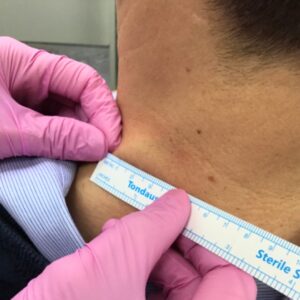
Lipoma size: 8cm x 5cm
Location: City Dermatology Clinic, London
Anaesthetic: Local anaesthetic
⚠️ Please note: This article includes surgical images and video footage. Content may not be suitable for all viewers.
The Patient’s Lipoma
This patient presented with a large lipoma on the right posterior shoulder that had been growing slowly over more than six years. By the time they sought treatment, the growth measured 8cm x 5cm and had reached a size where it caused genuine discomfort.
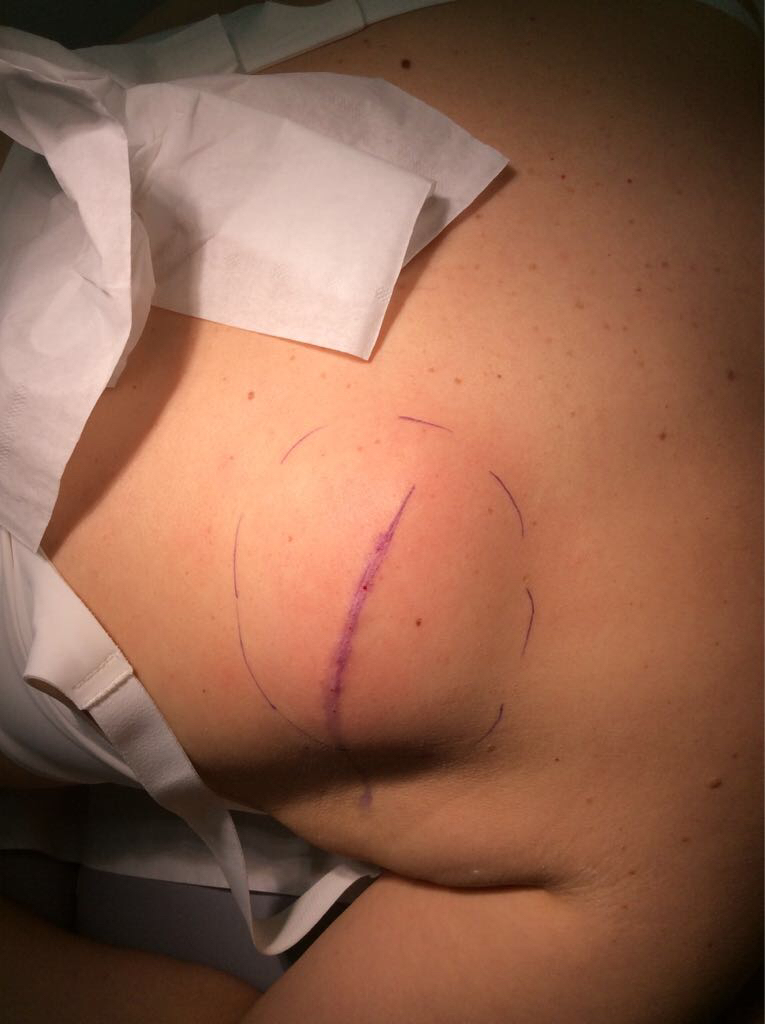
The lipoma’s characteristics:
- Size: 8cm x 5cm (significantly larger than typical shoulder lipomas)
- Location: Right posterior shoulder with partial submuscular involvement
- Duration: Present for 6+ years, progressively enlarging
- Symptoms: Discomfort when sitting back in chairs or leaning against surfaces
- Clinical finding: Mobile over superficial tissues, but reduced mobility when engaging the latissimus dorsi and parascapular muscles, indicating deeper extension
The patient sought removal due to the increasing size and the practical difficulties it caused in daily life.
Why This Surgery Was More Complex
Most lipomas sit in the subcutaneous layer (the fatty tissue just beneath the skin). They’re relatively straightforward to remove because they’re contained in one layer.
This lipoma was different. Clinical examination revealed partial submuscular involvement, meaning part of the growth extended beneath the muscle layer (specifically the latissimus dorsi and parascapular muscles).
This deeper extension required more careful surgical technique to ensure complete removal while preserving the surrounding structures and minimising the risk of recurrence.
The Surgical Procedure
Dr Parviz performed the removal as a day procedure under local anaesthetic. The patient was awake throughout but felt no pain in the treatment area.
What the surgery involved:
1. Local anaesthetic administration
Lignospan (a long-acting local anaesthetic) was infiltrated around the lipoma to ensure complete numbness of the area.
2. Surgical incision and dissection
A carefully planned incision was made to access the lipoma. Dr Parviz then performed meticulous dissection to separate the lipoma from surrounding tissues.
3. En bloc excision
The lipoma was removed en bloc, meaning it was excised in one complete piece rather than being broken up or removed in sections. This approach ensures complete removal and allows the entire specimen to be examined by histology.
4. Haemostasis
All bleeding points were carefully controlled to minimise bruising and ensure proper healing.
5. Layered closure
The wound was closed in layers using 4.0 Monocryl absorbable sutures. This technique supports proper healing and helps minimise scarring.
6. Sterile dressing
A Tegaderm sterile dressing was applied to protect the wound.
The entire lipoma was sent for histological analysis to confirm the diagnosis and exclude any concerning pathology.
What the Patient Was Told
Before proceeding with the surgery, Dr Parviz discussed the following with the patient:
Risks and considerations:
- Risk of recurrence: While en bloc excision aims for complete removal, lipomas can occasionally recur, particularly when there has been submuscular involvement
- Scarring: Any procedure that breaks the skin will leave a scar. The size and appearance depend on factors including skin type, location, and individual healing characteristics. Unfavourable scarring such as keloid formation is possible
- Histology importance: All removed tissue is sent for examination to confirm the diagnosis and ensure nothing concerning has been missed
- Follow-up availability: The patient has open follow-up free of charge to contact the clinic if any concerns arise post-procedure
These risks apply to all surgical procedures, and individual outcomes vary.
Why Histology Matters
Every lipoma removed at City Dermatology Clinic is sent for histological examination, regardless of how typical it appears clinically.
While lipomas are almost always benign (non-cancerous), histology serves several important purposes:
- Confirms the diagnosis
- Rules out rare variants that may require different follow-up
- Ensures no concerning features have been missed
- Provides documentation for the patient’s medical records
This is standard practice and provides reassurance for both patient and surgeon.
When Is Lipoma Removal Appropriate?
Lipomas are common, benign fatty growths that develop under the skin. They’re one of the most frequently occurring soft tissue tumours, affecting approximately 1 in 100 people.
Most lipomas remain small and cause no problems. They don’t require treatment simply because they exist.
However, removal may be considered when lipomas:
- Grow large enough to cause discomfort or restrict movement
- Are in locations that interfere with daily activities (as in this case)
- Continue to increase in size over time
- Are in visible locations and cause cosmetic concern
- Cause uncertainty or anxiety that requires diagnostic confirmation
What makes a lipoma “complex”?
Factors that increase surgical complexity include:
- Size: Larger than 5cm
- Location: Deep-seated or near neurovascular structures
- Depth: Submuscular or subfascial involvement
- Multiple compartments: Extension into different tissue planes
This patient’s lipoma met several of these criteria, making it a technically demanding removal that required surgical expertise.
About Mr Parviz Sadigh
Mr Parviz Sadigh is a Consultant Plastic and Reconstructive Surgeon at City Dermatology Clinic, London. He is recognised for his expertise in complex soft tissue procedures, microsurgical reconstruction, and reconstructive surgery of the extremities.
Qualifications and training:
- MBChB (University of Bristol, 2004)
- MRCS (2007)
- FRCS (Plast) (2014)
- Honorary Senior Lecturer, Microsurgery Master’s Programme, Barts and The London School of Medicine and Dentistry
Mr Sadigh has completed specialist training in London followed by international fellowships focusing on trauma and microsurgery in Taiwan, Japan, China, and South Korea.
His practice encompasses:
- Complex lipoma and cyst removal
- Reconstructive surgery following trauma
- Facial reconstruction and resurfacing
- Microsurgical procedures
- Body contouring procedures
He practices at City Dermatology Clinic in London and maintains a surgical practice in Dubai.