Skin tags are common, benign skin growths that affect people of all ages. While they are medically harmless in most cases, many patients seek advice about removal, particularly when skin tags catch on clothing, bleed, or appear in visible or sensitive areas. One of the most frequent questions asked is whether skin tag removal is available on the NHS.
In the UK, skin tag removal is not routinely funded by the NHS. We explain how NHS decisions are made, when referral may be considered, what the typical NHS pathway looks like, and why many patients explore private assessment when NHS treatment is not offered.
Does the NHS Remove Skin Tags?
In most cases, the NHS does not provide skin tag removal.
Skin tags are usually classified as cosmetic or low clinical priority, meaning they fall outside the treatments routinely funded by the NHS.
Are Skin Tags Dangerous?
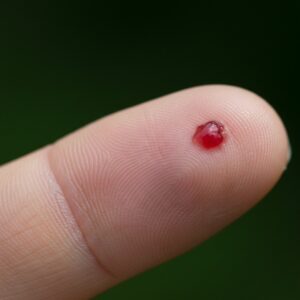
Skin tags are benign and are not a form of skin cancer. In most cases, they do not require medical treatment.
However, assessment may be appropriate if a lesion:
- Bleeds repeatedly
- Becomes painful or inflamed
- Changes in colour, size, or shape
- Does not resemble a typical skin tag
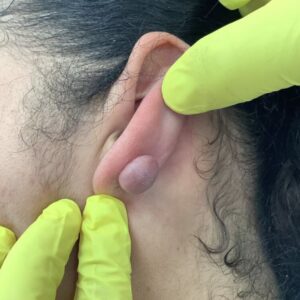
This distinction is important because several other skin conditions can look similar to skin tags, including warts, moles, seborrhoeic keratoses, and certain benign tumours.
Why Skin Tag Removal Is Not Routinely Funded
The NHS prioritises treatment based on medical necessity rather than appearance. Because skin tags are:
- Non-cancerous
- Common in the general population
- Often asymptomatic
they are not considered a priority for public funding.
GPs and commissioners are required to follow local funding policies, which generally state that removal of benign skin lesions is not indicated unless there is a clear medical reason.
When Might the NHS Consider Referral?
Although routine removal is not funded, NHS assessment or referral may be considered in limited situations.
These can include:
- Diagnostic uncertainty
If a GP is unsure whether a lesion is a skin tag or another type of growth, referral for specialist opinion may be appropriate. - Functional impairment
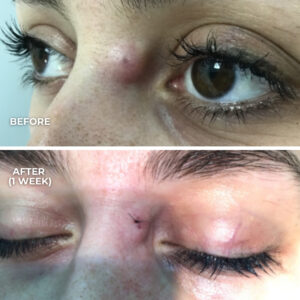
For example, a skin tag on the eyelid that interferes with vision. - Recurrent trauma or bleeding
Particularly if the lesion repeatedly catches on clothing or jewellery. - Unusual features
Such as rapid change, pigmentation changes, or ulceration.
Even in these situations, referral does not guarantee removal. Many referrals are declined following triage, and local Integrated Care Boards (ICBs) apply strict criteria.
The Typical NHS Pathway for Skin Tags
Patients enquiring about NHS removal usually follow a pathway similar to this:
1. GP Appointment
The GP examines the lesion to determine whether it appears to be a typical skin tag.
2. Referral Decision
If the lesion is benign and asymptomatic, referral is unlikely. If there is uncertainty or a functional issue, referral may be considered.
3. Triage or Specialist Review
Many referrals are reviewed remotely and declined if they do not meet funding criteria.
4. Waiting Times
If accepted, waiting times can be long, and removal may still not be offered. It is important to note that same-day removal is not part of standard NHS care for skin tags.
Does Location Affect NHS Decisions?
Location can influence whether referral is considered, although it does not guarantee treatment.
- Eyelid skin tags
May be assessed if vision is affected or diagnosis is uncertain. - Groin or perianal skin tags
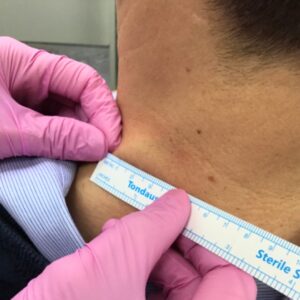
Sometimes assessed if symptoms such as pain or recurrent trauma are present. - Neck, underarm, or trunk skin tags
Almost always classed as cosmetic and not funded.
Each case is assessed individually, and local policy plays a significant role.
Why Many Patients Seek Private Assessment
Because NHS removal is rarely offered, many patients choose private clinics for assessment and management of skin tags.
Common reasons include:
- Wanting confirmation of what the lesion actually is
- Long NHS waiting times
- Multiple skin tags requiring assessment in one visit
- Lesions in visible or sensitive areas
- Preference for a planned, elective approach
Private assessment does not replace NHS care but provides an alternative route when NHS treatment is not available.
What Happens During a Private Assessment?
During a private consultation, a clinician will:
- Examine the lesion and confirm whether it is a skin tag
- Consider alternative diagnoses if the appearance is atypical
- Discuss whether removal is appropriate
- Explain available treatment options, risks, and aftercare
Suitability for skin tag removal depends on factors such as location, size, number of lesions, and individual health considerations.
Can Skin Tags Be Removed on the Same Day?
In private settings, same-day removal may be possible in some cases, depending on clinical assessment. However, this is not guaranteed and depends on:
- Confirmation of diagnosis
- Location of the lesion
- Presence of inflammation or infection
- Consent and clinical suitability
Assessment always comes first.
Why Self-Diagnosis Can Be Misleading
Many patients assume a lesion is a skin tag based on appearance alone. This can be misleading.
Conditions commonly mistaken for skin tags include:
- Viral warts
- Moles
- Seborrhoeic keratoses
- Neurofibromas
- Certain cysts
Accurate identification is important because treatment options and risks vary between conditions.
Home Removal and DIY Treatments
Home removal methods are widely discussed online, but they carry risks.
Problems can include:
- Bleeding or infection
- Incomplete removal
- Scarring
- Treating the wrong condition
The NHS does not recommend self-removal, and clinicians often see complications arising from DIY attempts.