Finding a lump or cyst in the groin can be worrying, particularly because the area is sensitive and changes are often noticed suddenly. Some people discover a small, painless lump that has been present for some time, while others notice swelling, tenderness, or a change in the skin that raises concern. In many cases, groin lumps are benign, but the range of possible causes means that assessment is sometimes needed to clarify what the lump represents.
This article explains what a lump or cyst in the groin may be, outlines common causes and types, and clarifies when a medical assessment is recommended. The aim is to support understanding and reduce uncertainty, rather than to encourage self-diagnosis.
What is a groin cyst?
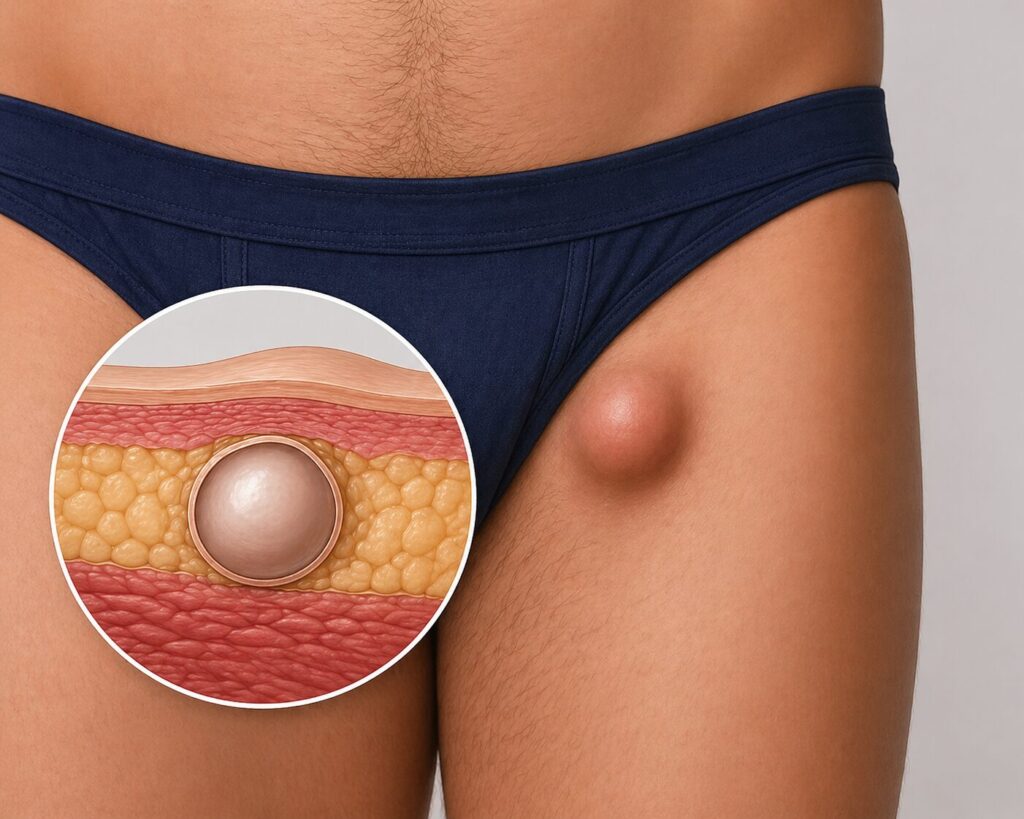
A groin cyst is a closed sac under the skin that contains fluid or semi-solid material. These cysts usually develop when skin cells, hair follicles, or oil glands become blocked. The groin is a common site for cyst formation because the skin in this area is subject to friction, moisture, and hair growth, all of which can contribute to blockage.
Groin cysts are often:
- Smooth and rounded
- Slow growing
- Mobile under the skin
- Painless, unless inflamed or infected
However, not all lumps in the groin are cysts. Swollen lymph nodes, hernias, abscesses, and other skin or soft-tissue conditions can present in a similar way. For this reason, a lump in the groin should not be assumed to be a cyst without assessment.
A clinician can evaluate the size, location, texture, and behaviour of a groin lump and advise whether it is consistent with a cyst or whether further investigation is appropriate.
Common causes of lumps or cysts in the groin area
Lumps or cysts in the groin often develop due to local skin and tissue factors rather than an underlying illness. The area is exposed to constant movement, friction from clothing, moisture, and hair growth, all of which can contribute to blockage or irritation beneath the skin.
Common contributing factors include:
- Blocked hair follicles or oil glands, leading to the gradual formation of a cyst
- Friction and pressure, which can irritate the skin and encourage inflammation or blockage
- Sweating and moisture, creating an environment where cysts or secondary infection are more likely
- Previous inflammation or minor infection, which can leave behind a residual lump
Some lumps appear after shaving or waxing, while others develop without an obvious trigger. In certain cases, a lump may enlarge, become tender, or show signs of infection, particularly if bacteria enter the cyst through the skin surface.
Because several different conditions can arise from similar triggers, the cause is not always clear without examination. A clinician considers how long the lump has been present, whether it changes in size, and whether there are associated symptoms such as pain, redness, or discharge.
Types of cysts that can affect the groin
Several types of cysts can occur in the groin, each with slightly different characteristics. These include:
- Epidermoid cysts, which form when skin cells become trapped under the surface rather than shedding normally. These are among the most common cysts found in the groin.
- Sebaceous-type cysts, related to blocked oil glands, often presenting as slow-growing, firm lumps.
- Inflammatory cysts, which may be linked to recurring skin inflammation in hair-bearing areas and can become painful during flare-ups.
- Infected cysts or abscess-like cysts, where bacteria cause swelling, redness, and tenderness within an existing cyst.
Although these cysts are generally benign, they can resemble other groin lumps such as swollen lymph nodes or soft-tissue swellings. The appearance alone is not always enough to distinguish between them.
Assessment allows a clinician to determine whether a lump is likely to be a cyst, identify the specific type where possible, and advise whether monitoring, further investigation, or treatment should be considered.
Symptoms and changes to look out for
Lumps or cysts in the groin can remain unchanged for long periods, but some develop features that prompt assessment. Paying attention to how a lump behaves over time can be more useful than focusing on its size alone.
Changes that may be noted include:
- Gradual increase in size
- New tenderness or pain, particularly with movement
- Redness or warmth of the overlying skin
- Discharge of fluid or pus
- Recurrent swelling after periods of settling
Some people notice that a lump becomes more uncomfortable during physical activity, sweating, or when clothing rubs against the area. Others may find that a previously painless lump becomes inflamed following minor skin trauma, shaving, or infection.
While these features do not automatically indicate a serious problem, they suggest that the lump is active or changing. A clinician can assess whether the changes are consistent with an inflamed cyst, infection, or another cause that may need further investigation.
Conditions commonly confused with groin cysts
Not all lumps in the groin are cysts. Several other conditions can appear similar, particularly in early stages.
These include:
- Swollen lymph nodes, which often feel firm and may be tender, especially during infection or inflammation elsewhere in the body
- Hernias, which can cause a soft or firm bulge that may become more noticeable when standing or straining
- Abscesses, which are collections of infection under the skin and are often painful and warm
- Other skin or soft-tissue growths, which may vary in texture and behaviour
Because these conditions can overlap in appearance, it is not possible to identify the cause with certainty based on touch or appearance alone. Assessment helps distinguish between skin-based cysts and deeper causes of groin lumps.
When to seek medical assessment
Medical assessment is recommended if a lump or cyst in the groin:
- Persists for more than a few weeks
- Increases in size or becomes painful
- Shows signs of infection, such as redness, warmth, or discharge
- Reappears repeatedly in the same area
- Causes uncertainty or concern, even if it is not painful
A medical assessment allows the area to be examined carefully and, where needed, further tests to be arranged. In many cases, reassurance is all that is required. In others, assessment helps determine whether monitoring, treatment, or referral is appropriate.