Every year in the UK, around 17,500 people are diagnosed with melanoma, the most serious form of skin cancer, making it the fifth most common cancer nationally. Alarmingly, 86% of melanoma cases are preventable, a fact often overlooked as UV exposure and lifestyle choices continue to drive rising incidence.
Recognising whether a mole is benign or potentially cancerous can shape outcomes. When detected early, melanoma survival rates in England reach nearly 87% at 10 years across all age groups, and over 93% for people aged 15–44. However, survival drops sharply once the disease advances beyond its early stage. That’s why knowing the difference, and acting fast, is so important.
Understanding the signs of a suspicious mole lies at the heart of early detection. In this guide, we’ll explain how to tell whether a mole is likely benign or needs attention. You’ll learn the essential warning signs, how doctors assess moles, and when it makes sense to book a professional mole check, or same-day removal at City Dermatology Clinic London.
Understanding Moles and Skin Cancer Risk
A mole (medical term: melanocytic naevus) is a cluster of pigment-producing skin cells called melanocytes. Most people have between 10 and 40 moles, and they can appear anywhere on the body. The majority are harmless, but some can develop into melanoma, the most serious type of skin cancer.
Common Moles vs Atypical Moles
- Common moles are uniform in colour, round or oval in shape, and usually less than 6mm in diameter.
- Atypical moles (also called dysplastic naevi) may be larger, have irregular borders, or show more than one colour. These are not cancerous, but they carry a higher risk of developing into melanoma, especially if you have several of them.
Risk Factors for Mole Changes
Certain factors increase the chance of a mole becoming cancerous:
- Excessive UV exposure from sunlight or tanning beds.
- Fair skin, light hair, and light eyes, less natural melanin protection.
- Family history of melanoma or atypical moles.
- Having many moles (more than 50) or large congenital moles present from birth.
- Weakened immune system due to illness or medication.
Why Early Detection Matters
Melanoma is far less common than basal cell carcinoma or squamous cell carcinoma, but it is more aggressive and can spread quickly. When found early, treatment is often straightforward and survival rates are high. Once it spreads to lymph nodes or other organs, survival rates drop significantly, which is why recognising warning signs early is critical.
Key Signs a Mole May Be Cancerous
Dermatologists use a combination of visual clues and patient history to decide whether a mole should be investigated further. One of the most widely recognised tools is the ABCDE rule, developed to help spot changes linked to melanoma.
The ABCDE Rule
- A – Asymmetry: One half of the mole does not match the other.
- B – Border: Irregular, blurred, notched, or scalloped edges.
- C – Colour: More than one shade (brown, black, tan, red, white, or blue) within the same mole.
- D – Diameter: Greater than 6mm (about the size of a pencil eraser), although smaller moles can still be melanoma.
- E – Evolving: Any change in size, shape, colour, or symptoms such as bleeding or crusting.
Other Warning Signs
While the ABCDE rule is effective, some melanomas may not follow it perfectly. Other red flags include:
- A new mole appearing after age 40.
- Persistent itching, tenderness, or pain.
- Surface changes such as scaling, oozing, or bleeding.
- Rapid growth over weeks or months.
Why Self-Assessment Alone Isn’t Enough
Some harmless moles may look irregular, while some melanomas can appear small and regular. Only a trained dermatologist can make an accurate assessment, often using dermatoscopy or biopsy to confirm a diagnosis. Relying solely on home checks can delay essential treatment.
How Doctors Check a Mole
When you visit a dermatologist or plastic surgeon with concerns about a mole, the assessment goes beyond a quick visual glance. The aim is to accurately determine whether the mole is benign, pre-cancerous, or malignant, and to decide whether removal or further testing is needed.
Visual Examination
A doctor will first take a detailed history, asking about:
- How long you’ve had the mole.
- Any recent changes in appearance or symptoms.
- Personal or family history of skin cancer.
They will then examine the mole under strong lighting, looking for asymmetry, irregular borders, uneven colouring, and other warning signs.
Dermatoscopy
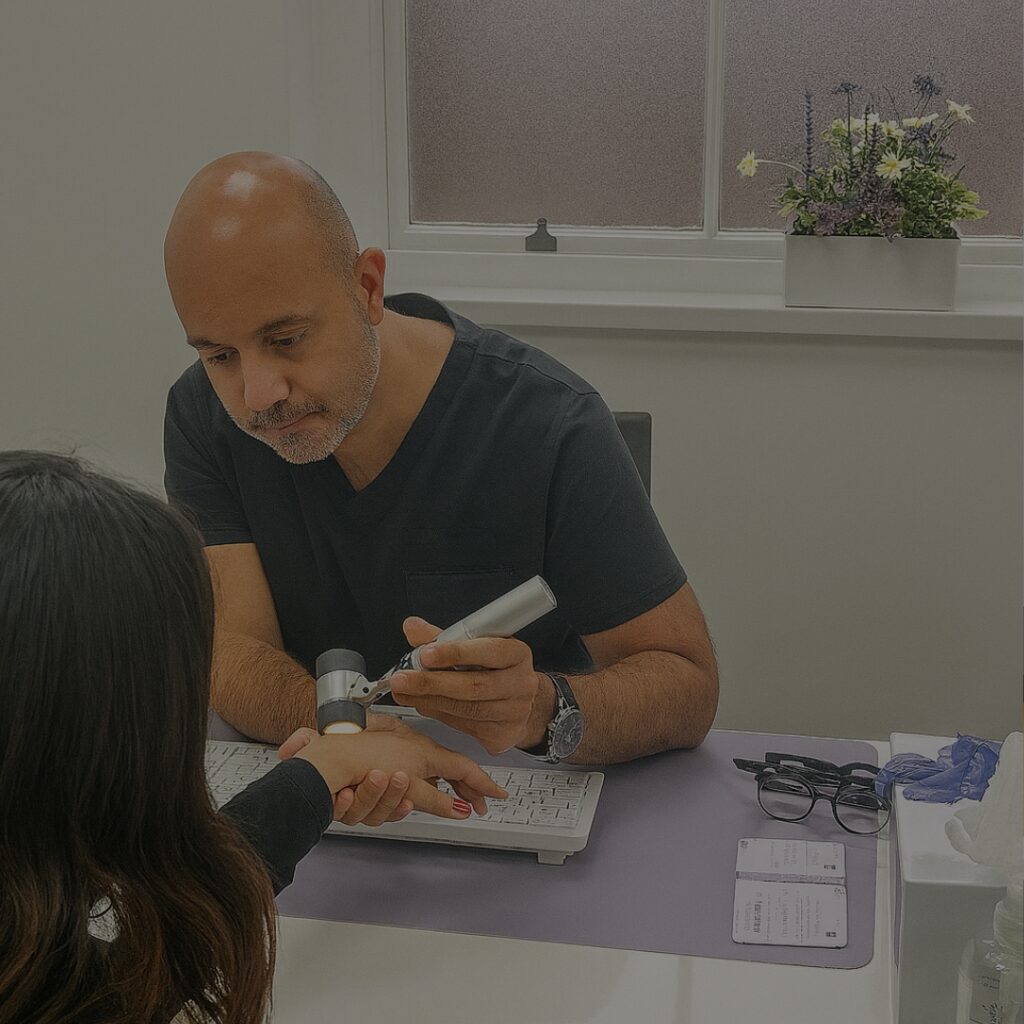
Dermatoscopy (or dermoscopy) involves using a handheld device called a dermatoscope, a magnifier with polarised light, to see beneath the skin’s surface. This allows the doctor to detect subtle patterns and pigmentation structures invisible to the naked eye. Studies show that dermatoscopy increases melanoma detection accuracy while reducing unnecessary excisions of benign moles.
Digital Mole Mapping
For patients with multiple moles or higher risk, digital mole mapping creates a photographic record of your skin. Changes can then be tracked over time, helping to identify new or evolving lesions early.
Biopsy and Histology
If a mole appears suspicious, the safest option is to remove it and send it for histology, microscopic analysis in a laboratory. This is the only way to confirm whether a mole is cancerous. Depending on the type and location of the mole, removal may be done via shave excision, surgical excision, or less commonly other methods.
Getting Peace of Mind with a Mole Check or Removal in London
If you’ve noticed a mole that has changed, feels different, or simply doesn’t look right, it’s always best to have it checked. Early diagnosis means simpler treatment and far better long-term outcomes, and it can save lives.
At City Dermatology Clinic London, our consultant dermatologists and plastic surgeons provide thorough mole checks using dermatoscopy and, where needed, digital mole mapping. If a mole removal is advised, we can often perform the procedure on the same day, using precise surgical techniques and arranging histology for complete reassurance.
Many patients also choose removal for cosmetic reasons, to improve appearance, prevent irritation, or remove a mole that catches on clothing or jewellery. Whatever your reason, our goal is the same: to give you safe, professional care and results that look as natural as possible.
If you’re unsure about a mole, don’t wait for it to change. Book a consultation at our City of London or Harley Street clinic and get peace of mind from a trusted team.