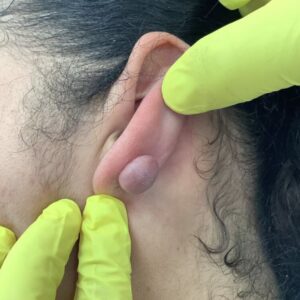
A dermoid cyst is a benign lump that is often present from birth, although it may not become noticeable until infancy or early childhood. Parents commonly discover these cysts as a small, firm swelling under the skin, often on the face, scalp, or around the eyes.
What Is a Dermoid Cyst in Children?
A dermoid cyst is a benign (non-cancerous) growth that is usually present from birth, even if it is not noticed until later in childhood. These cysts develop during early foetal development, when skin and skin-related cells become trapped beneath the surface instead of forming normally on the outside of the body.
Because of how they form, dermoid cysts can contain a mixture of tissues commonly found in skin, such as hair follicles, sebaceous (oil) glands, and sometimes fatty material. This is why they tend to feel firm, smooth, and slow-growing when examined.
In children, dermoid cysts often grow very gradually over time. They are not caused by infection, injury, or anything a parent has done. Many are noticed incidentally, for example during routine washing, brushing hair, or as a child grows and facial features become more defined.
Although dermoid cysts are benign, assessment is still important. Other lumps and bumps in children can look similar, and a clinical examination helps confirm whether a dermoid cyst is the most likely explanation and whether any further investigation is needed.
Common Locations of Dermoid Cysts in Children
Dermoid cysts in children tend to occur in predictable anatomical locations, reflecting how the tissues fuse during early development. The location often influences how noticeable the cyst is and how it is assessed.
Common sites include:
- Around the eyes and eyebrows
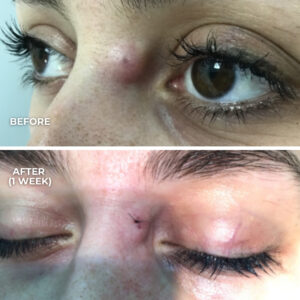
This is one of the most frequent locations in children, particularly near the outer edge of the eyebrow. These cysts may become more noticeable as a child grows. - Scalp
Dermoid cysts on the scalp are often felt as firm, rounded lumps beneath the skin. Hair usually grows normally over the area. - Face and nose
Some dermoid cysts occur along the midline of the face, including near the nose. Midline locations may require more careful assessment. - Neck
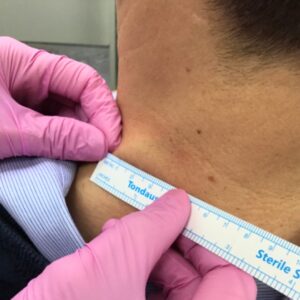
Less commonly, dermoid cysts may appear in the neck region and are usually slow-growing.
The location matters because it can influence:
- How easily the cyst is identified during examination
- Whether imaging is considered
- How removal is planned, if treatment is recommended
For example, cysts near the eye or along the midline of the face may be assessed more cautiously to understand their depth and any connection to nearby structures.
Symptoms and When Assessment Is Recommended
In many children, a dermoid cyst causes no symptoms beyond the presence of a lump. Parents often describe noticing a small, firm swelling that does not seem painful and changes very slowly over time.
Typical features parents report include:
- A painless lump that feels firm or rubbery
- Skin over the cyst appearing normal
- Gradual enlargement as the child grows
- No redness, warmth, or signs of infection
Assessment is usually recommended if:
- A lump is increasing in size
- The location raises clinical questions (for example, near the eye or midline of the face)
- There is uncertainty about the diagnosis
- Parents want clarity or reassurance
Although dermoid cysts are benign, not every lump in a child is a dermoid cyst. Clinical assessment helps distinguish dermoid cysts from other conditions such as lymph nodes, epidermoid cysts, or developmental lesions. A consultation also allows parents to ask questions and understand whether monitoring or treatment may be appropriate.
How Dermoid Cysts Are Assessed in Children
Assessment of a suspected dermoid cyst in a child begins with a careful clinical examination. The clinician will look at the size, location, and feel of the lump, as well as how long it has been present and whether it has changed over time. Parents are often asked when they first noticed the swelling and whether it has grown gradually or remained stable.
In many cases, a dermoid cyst can be suspected based on its typical features and location. However, cyst removal assessment is individualised. Certain locations, particularly around the eye, nose, or midline of the face or scalp, may prompt more detailed evaluation to understand how deep the cyst lies and whether it has any connection to underlying structures.
Imaging is not always required, but may be considered in some situations, such as:
- Midline facial or scalp cysts
- Cysts close to the eye or nose
- Uncertainty about the diagnosis on examination
Where imaging is used, this is done to support planning and safety, rather than as a routine step. The goal of assessment is to confirm the likely diagnosis, rule out other causes of a lump, and decide whether monitoring or treatment is appropriate.
Treatment and Surgical Removal Options
Not all dermoid cysts in children require immediate treatment. In some cases, monitoring may be appropriate, particularly if the cyst is small, stable, and not causing concern. When removal is considered, this is usually because of factors such as progressive growth, location, cosmetic considerations, or parental preference following assessment.
Surgical removal involves excising the cyst in its entirety, including its lining, to reduce the chance of recurrence. In children, this is planned carefully with attention to the child’s age, the cyst’s location, and the surrounding anatomy. The timing and approach to surgery are individual decisions made after discussion with parents or carers.
Where surgery is recommended, experience in paediatric plastic surgery is important, particularly for cysts on the face, scalp, or near the eyes. At City Dermatology Clinic, assessment and surgical management of dermoid cysts in children may involve a consultant plastic surgeon such as Dr Jana Torres-Grau, whose practice includes paediatric and reconstructive surgery. Any discussion of treatment focuses on suitability and safety, rather than assumptions about outcome.
Recovery, Scarring, and What Parents Can Expect
Recovery after dermoid cyst removal in children is generally straightforward, but it varies depending on the size and location of the cyst, as well as the surgical approach used. Parents are usually given clear aftercare instructions tailored to the child and the procedure performed.
In the short term, it is common for there to be some swelling or mild discomfort around the surgical site. This typically settles over time. Follow-up may be arranged to review healing and, where relevant, remove sutures.
Scarring is an important consideration for parents, particularly for cysts on the face or scalp. Any procedure that breaks the skin can leave a scar, and the appearance of scarring varies between individuals. Factors such as skin type, healing response, and surgical planning all play a role. These points are usually discussed during consultation so expectations are realistic.
Overall, the purpose of assessment and, where appropriate, treatment is to address the cyst safely while supporting a child’s long-term wellbeing. A consultation provides parents with the opportunity to understand the diagnosis, discuss options, and decide on the most appropriate next step for their child.