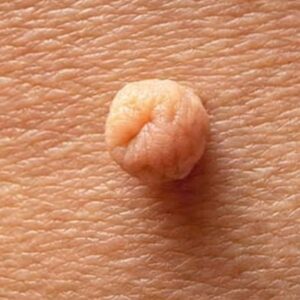
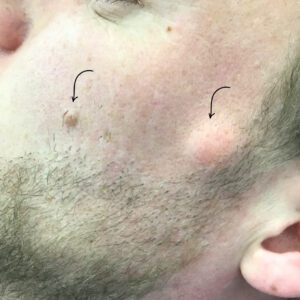
Cosmetic mole removal is often requested when a mole is benign but causes concern because of its appearance, location, or prominence. While the motivation may be cosmetic, safe and appropriate removal still depends on careful medical assessment.
Moles vary widely in type, depth, and behaviour. Some can be removed for aesthetic reasons, while others require closer evaluation to rule out medical concerns before any cosmetic treatment is considered. For this reason, cosmetic mole removal sits at the intersection of dermatology and surgery, combining skin cancer expertise with techniques designed to minimise visible scarring.
What Is Cosmetic Mole Removal?
Cosmetic mole removal refers to the removal of a mole primarily for appearance-related reasons rather than because of symptoms or medical suspicion. Common reasons include visibility on the face or neck, irritation from clothing or shaving, or dissatisfaction with how a mole looks.
Despite the term “cosmetic,” the process is still a medical procedure. Before removal, a clinician must determine whether the mole is suitable for cosmetic treatment and whether further investigation is required. Some moles that appear harmless can still warrant careful assessment.
Cosmetic mole removal may involve different techniques depending on the mole’s characteristics, including its size, depth, pigmentation, and location. The aim is to remove the lesion safely while achieving an acceptable cosmetic outcome, acknowledging that scarring is always a possibility.
Why Clinical Assessment Comes First
Assessment is the most important step in cosmetic mole removal. A mole should never be treated purely as a cosmetic concern without first confirming that it is appropriate to do so.
During assessment, a clinician evaluates:
- The mole’s colour, shape, and symmetry
- Whether it is flat or raised
- Any recent changes in size, colour, or sensation
- The surrounding skin and overall mole pattern
In some cases, dermoscopic examination is used to look at structures beneath the surface of the skin. This helps distinguish between benign moles, atypical lesions, and moles that require further investigation.
If there is any uncertainty, removal may still be appropriate, but with histological analysis of the tissue. This ensures that cosmetic treatment does not compromise medical safety. Assessment also helps determine the most suitable removal method and sets realistic expectations about healing and scarring.
The Role of Dermatologists in Mole Assessment and Removal
Dermatologists play a central role in cosmetic mole removal by providing specialist expertise in skin diagnosis and skin cancer assessment. Their training allows them to identify subtle features that may not be obvious to the untrained eye.
In cosmetic cases, dermatologists:
- Assess whether a mole is benign and suitable for cosmetic removal
- Identify moles that require histology or further investigation
- Advise on whether removal is appropriate or necessary
- Select or recommend suitable removal techniques based on skin and lesion type
Dermatologists are particularly involved when moles are pigmented, atypical in appearance, or when patients have multiple moles or a history of skin cancer. Their involvement ensures that cosmetic decisions are made with medical safety as the priority.
In many cases, dermatologists work alongside surgeons to balance diagnostic accuracy with cosmetic considerations, especially for visible or sensitive areas.
The Role of Plastic Surgeons in Cosmetic Mole Removal
Plastic surgeons are often involved in cosmetic mole removal when appearance, scar placement, and wound closure are key considerations. Their training focuses on surgical precision, tissue handling, and techniques designed to support optimal healing, particularly in visible or high-tension areas.
In cosmetic mole removal, plastic surgeons:
- Plan excision and closure to minimise scar visibility
- Consider natural skin lines and tension patterns
- Use layered closure techniques when appropriate
- Manage moles in anatomically sensitive areas such as the face, neck, scalp, and chest
Plastic surgeons are commonly involved when moles are larger, deeper, or require full surgical excision. Their expertise is particularly relevant when stitches are needed or when scar quality is a primary concern.
In clinics where dermatologists and plastic surgeons work together, decisions are guided by both diagnostic accuracy and surgical technique. This collaborative approach allows cosmetic outcomes to be considered without compromising medical safety.
Types of Moles Commonly Removed for Cosmetic Reasons
Moles differ significantly in appearance and structure. Understanding the type of mole helps determine whether cosmetic removal is appropriate and which technique may be considered.
Common mole types removed for cosmetic reasons include:
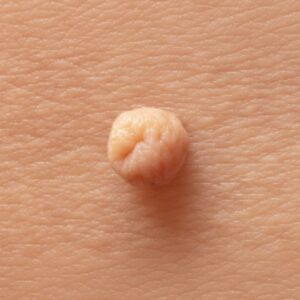
- Intradermal moles
Often raised, skin-coloured or light brown, and commonly found on the face or neck. - Compound moles
Slightly raised and pigmented, involving both surface and deeper skin layers. - Junctional moles
Typically flat and pigmented, located at the junction between skin layers. - Congenital moles
Present from birth and variable in size and depth. Assessment is particularly important before cosmetic removal. - Hairy moles
Moles with hair growth, which can be a cosmetic concern depending on location.
Not all moles are suitable for cosmetic removal alone. Some require histological analysis or a more cautious surgical approach, which is determined during assessment.
Cosmetic Mole Removal by Body Area
The body location of a mole plays a significant role in both technique selection and healing expectations. Skin thickness, movement, and visibility vary widely across different areas.
Common cosmetic removal sites include:
- Face and neck
High visibility areas where scar placement and healing are especially important. Dermatology assessment and surgical technique selection are critical. - Chest and upper back
Areas under greater skin tension, where scars may mature differently and require careful planning. - Scalp
Moles hidden by hair but prone to irritation from grooming. Healing is usually straightforward but location affects technique choice. - Arms and legs
Healing varies depending on movement and skin thickness. Scar appearance can take longer to settle in lower limbs. - Trunk and abdomen
Often less visible, but larger moles in these areas may still require surgical excision.
Each area presents different considerations, and expectations around scarring and healing are discussed during consultation.
Cosmetic Mole Removal Techniques
The technique used for cosmetic mole removal depends on the mole’s type, depth, pigmentation, and location. No single method is suitable for all moles, which is why technique selection follows clinical assessment.
Common techniques include:
- Shave excision
Removes raised moles at skin level without stitches. Often considered for superficial, benign moles where scarring risk is low and histology may or may not be required. - Surgical excision
Involves removing the mole and a margin of surrounding tissue, followed by closure with stitches. This technique allows for full histological analysis and is used for deeper or larger moles. - Electrocautery
Uses controlled heat to remove very small, superficial lesions and seal blood vessels. It is not suitable for pigmented or deeper moles requiring histology. - Laser treatment
Targets pigment in the skin and is limited to selected superficial lesions. Laser does not remove deeper tissue and does not provide tissue for analysis.
The choice of technique balances cosmetic goals with medical safety. In some cases, cosmetic concerns may be secondary to the need for complete removal and histological examination.
Scarring, Healing, and Long-Term Appearance
Scarring is an unavoidable consideration in any mole removal procedure. While techniques can be selected to minimise visible scarring, individual healing response plays a significant role in final appearance.
Factors influencing scarring include:
- Mole size and depth
- Removal technique
- Body location
- Skin type and pigmentation
- Individual tendency to form raised or widened scars
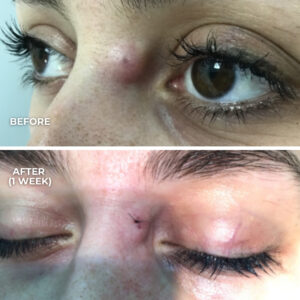
Early healing often involves redness or firmness at the removal site. Over time, scars typically soften and fade, although the process can take several months. Expectations around scarring are discussed during consultation so patients can make informed decisions.
Histology and Safety in Cosmetic Mole Removal
Even when a mole is removed for cosmetic reasons, histological analysis may still be recommended. Histology involves examining the removed tissue under a microscope to confirm the diagnosis.
Histology is particularly important when:
- A mole is pigmented or atypical
- There is uncertainty on assessment
- The mole has changed in appearance
- Full excision is performed
This step ensures that cosmetic treatment does not compromise medical safety. Not all techniques allow for histology, which is why assessment guides both method selection and aftercare planning.
Who May Be Suitable for Cosmetic Mole Removal
Suitability for cosmetic mole removal depends on several individual factors rather than appearance alone.
A clinician considers:
- The type and behaviour of the mole
- Medical history and skin cancer risk
- Location and size of the lesion
- Expectations around cosmetic outcome and scarring
Some moles may not be suitable for cosmetic removal alone, or removal may be deferred pending further investigation. Consultation allows these factors to be reviewed carefully.