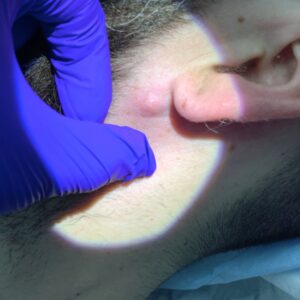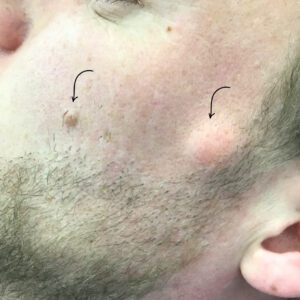
Developing new moles in adulthood isn’t unusual, but when they appear after the age of 50, it’s important to pay closer attention. While many new skin growths are harmless, the risk of melanoma and other skin cancers increases with age, making professional assessment essential.
Understanding why new moles appear later in life, and how to distinguish between harmless lesions and those that need further testing, can make all the difference in detecting problems early.
Why New Moles Can Appear Later in Life
Most moles develop in childhood or early adulthood, but new ones can form at any age. After 50, their appearance is usually influenced by a combination of skin ageing, cumulative sun exposure, and genetic factors.
Skin changes with age
As skin matures, it undergoes structural changes. Cell turnover slows down, and DNA repair mechanisms become less efficient. These changes mean that abnormal cell growths, such as moles or other pigmented lesions, are more likely to occur.
Sun exposure and UV damage over time
UV radiation from the sun is the biggest contributor to new mole formation in later life. Decades of exposure build up, and the damage can show up years later as pigmented lesions. This is why new moles are often seen on sun-exposed areas like the face, arms, and back.
Other contributing factors
- Hormonal changes: Though less common after midlife, hormonal fluctuations can still play a role.
- Immune system decline: A weaker immune system with age can make it harder for the body to suppress abnormal cell growth.
- Genetics: A family history of melanoma or atypical moles increases the likelihood of new lesions forming later in life.
When a New Mole Could Be a Concern
Not every new mole after 50 is dangerous, but any new pigmented lesion should be checked by a dermatologist. The older you are, the higher the chance that a new mole could be atypical or malignant.
Differences between harmless moles and suspicious lesions
- Harmless moles: Usually small, round, symmetrical, and uniform in colour.
- Suspicious moles: Irregular in shape, uneven in colour, larger than 6 mm, or changing over time.
The ABCDE rule for melanoma detection
Dermatologists recommend checking new or changing moles using the ABCDE guide:
- A – Asymmetry: One half doesn’t match the other
- B – Border: Edges are irregular, blurred, or jagged
- C – Colour: Multiple shades of brown, black, red, or white
- D – Diameter: Larger than 6 mm (about the size of a pencil eraser)
- E – Evolving: Any change in size, shape, colour, or sensation
Why age increases risk
Melanoma risk rises with age due to cumulative DNA damage from UV exposure. This makes it especially important for anyone over 50 to take new moles seriously and seek timely assessment.
Common Types of Skin Growths Mistaken for Moles
Not every new brown or raised spot on the skin is a mole. In fact, after 50, many growths that resemble moles are entirely different conditions.
Seborrhoeic keratoses
These are very common, harmless growths that often appear in middle age or later. They can be brown, black, or tan and may look waxy or wart-like. Unlike moles, they are not linked to melanoma risk.
Lentigines (age spots)
Also called “liver spots” or “sun spots,” lentigines are flat, brown patches caused by years of sun exposure. They are benign but can be cosmetically bothersome.
Other benign growths
Skin tags, cherry angiomas, and dermatofibromas are all common after 50 and can sometimes be confused with moles. A dermatologist can distinguish these easily with a dermoscopy exam.
Importance of Skin Checks After 50
The likelihood of skin cancer increases with age, making regular skin monitoring critical.
Self-examination and what to look for
Perform monthly skin checks in good lighting, using a mirror for hard-to-see areas. Watch for:
- New growths or pigmented spots
- Changes in existing moles
- Lesions that itch, bleed, or don’t heal
Role of professional dermatology assessments
Dermatologists use tools such as dermoscopy to examine moles in detail. If there’s any uncertainty, they may recommend a biopsy for definitive diagnosis.
Frequency of skin monitoring
- High-risk individuals (fair skin, history of sunburn, family history of melanoma) should have annual skin checks.
- Everyone over 50 should consider periodic professional skin reviews, even if no suspicious changes are noticed.
Diagnosis and Treatment Options
If a dermatologist is concerned about a new mole, further steps may be taken.
Dermoscopy and biopsy
A dermatoscope magnifies the skin to reveal patterns invisible to the naked eye. If a mole appears suspicious, a biopsy is performed to rule out melanoma or other skin cancers.
Mole removal techniques
Our doctors remove moles for cosmetic and medical reasons, this includes:
- Shave excision: For raised, benign moles
- Surgical excision: For suspicious moles, where the entire lesion is removed with a margin of healthy skin
- Laser removal: Sometimes used for cosmetic removal of benign lesions, though not recommended if there’s any concern about cancer
Preventive measures
- Daily sunscreen use (SPF 30+)
- Protective clothing outdoors
- Avoidance of tanning beds
- Awareness of the ABCDE rule for early detection